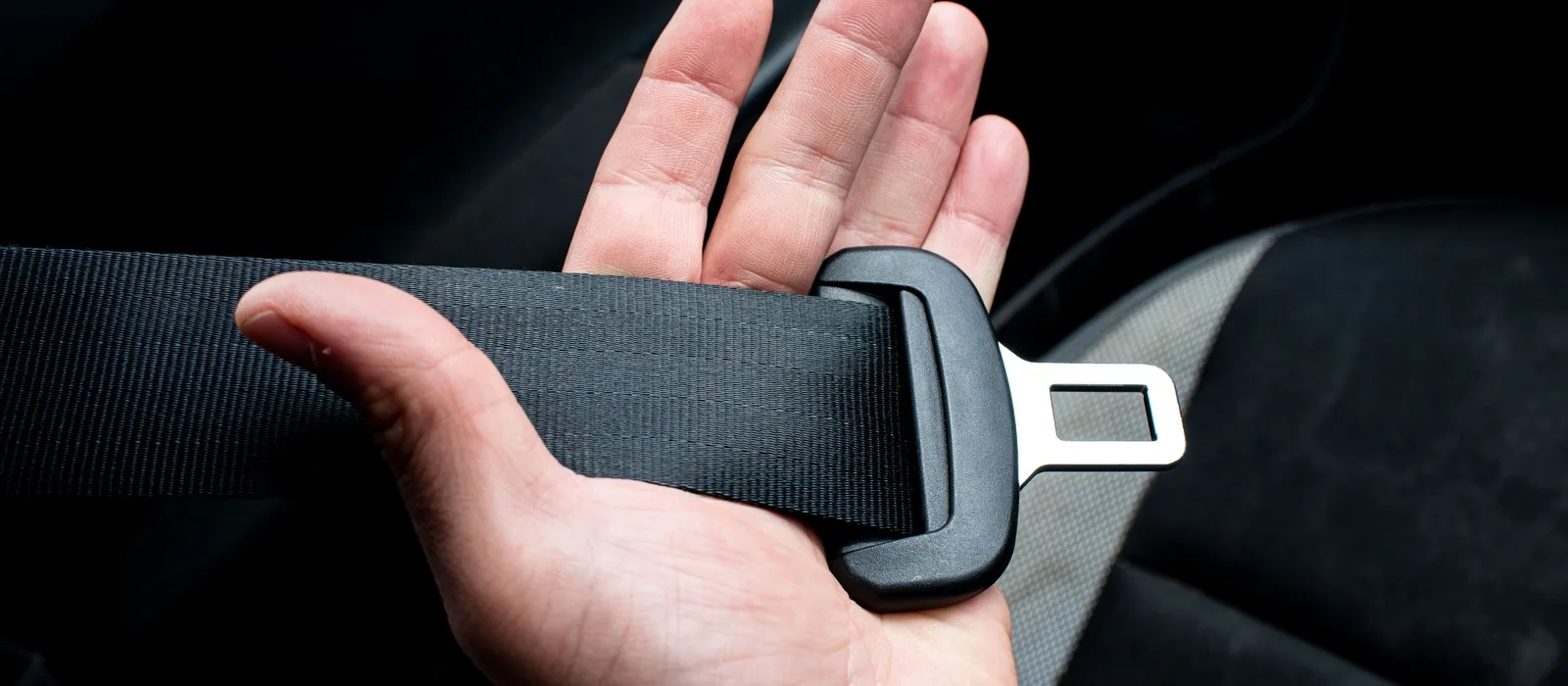
When your car was in a collision, the seat belts did their job and they paid for it. The pretensioner fired, the retractor locked, and now the belt will not pull out or retract. We rebuild your original belt back to the way it left the factory and ship it home, for a fraction of dealer cost.

A modern seat belt has a small pyrotechnic charge built into the assembly called a pretensioner. The instant the airbag control module reads a crash, it sends current to that charge, the charge fires, and a piston or rotary mechanism yanks the slack out of the belt and pulls it tight against your body in a few thousandths of a second. That is what holds you in the seat before the airbag ever inflates.
The catch is that the charge is a one-time device. A pretensioner fires once in a deployment and then it is spent. It cannot reset itself, and there is no button to re-arm it. After the charge goes off, the retractor usually locks solid, the buckle latch may seize, and the webbing can be scorched or frayed where it was pulled hard through the guide. The belt is now dead weight. It will not pull out, it will not retract, and it will not protect anyone in another collision.
A dealer answers this one way: throw the whole assembly in the trash and sell you a brand-new one, often for several hundred dollars per belt. We answer it a different way. We take your original belt apart in our shop, install a fresh pretensioner charge, free the locked retractor, repair or replace the buckle, and put new webbing on if yours is damaged. When we are done, your belt holds to factory specification again, because it is the same belt the engineers built the car around. A properly repaired belt is every bit as strong as the one that came off the line.
After a crash, a seat belt usually comes to us with more than one thing wrong. We address all of it in a single service so the whole assembly works as a unit again.
The explosive charge has gone off and cannot reset. We remove the spent unit and rebuild the pretensioner with a fresh charge so the belt pre-loads in a crash the way it was designed to. This is the heart of the job and the part dealers will not do.
When the pretensioner fires, the retractor often locks and refuses to spool the belt in or out. We free the mechanism, clean and reset the internals, and confirm it pays out and retracts smoothly under load.
Many vehicles have a second pretensioner in the buckle itself. After a deployment the latch can stick or refuse to release. We repair the buckle and its pretensioner so the tongue clicks in and pops out cleanly every time.
Scorched, cut, or frayed webbing gets replaced with new material rated to factory strength. We match the color to your original belt so the finished strap blends in next to the others in your car.
Not every seat belt is built the same. Manufacturers use one, two, or three pretensioner charges depending on the vehicle, and the count changes how the belt is rebuilt. The quickest way to tell is the connector: a single-stage belt has one plug, a dual-stage has two, a triple-stage has three. Pick yours below for the specifics.
One connector, one charge. The most common belt on older and economy vehicles. We rebuild the single pretensioner and free the retractor.
Single-stage repair →Two connectors, two charges. Common on mid-2000s and newer cars and trucks. Both stages get rebuilt so the belt loads in the right order.
Dual-stage repair →Three connectors, three charges. Found on newer and higher-end vehicles with advanced restraints. All three stages rebuilt and tested.
Triple-stage repair →Not sure how many stages your belt has? Count the plugs on the connector or call us at 501-988-0611 and we will walk you through it. You can also read the full pretensioner rebuild process for the mechanical detail.
You ship us the belt, we rebuild it, we ship it back ready to bolt in. The whole job runs through the mail and bolts back into the same anchors it came out of. Walk through the process on our how it works page.
Pull the belt assembly and mail it in. We send simple instructions so you remove the right part.
Fresh pretensioner charge, freed retractor, repaired buckle, new webbing if needed, then tested.
Your original belt comes home holding to factory spec. Reinstall it and the system is whole again.
A new belt assembly from the dealer can run several hundred dollars each, and many shops will not even sell the part separately. Rebuilding your original belt saves up to 80% against that. Pricing depends on the number of stages and what your belt needs. Call 501-988-0611 for your exact price.
Yes. We restore your original OEM belt and rebuild the pretensioner with a fresh charge, then load-test the assembly before it ships. A properly repaired belt holds to factory specification, the same as the day the car was built, because it is your own part, engineered and rated for your exact vehicle.
Dealers are set up to sell the whole assembly new, not to take it apart and rebuild it. That is the expensive route, and on some vehicles they will tell you the belt is not even available separately. Rebuilding the belt you already own is what we have done since 1997.
Look at the electrical connector on the pretensioner. One plug is single-stage, two plugs is dual-stage, three plugs is triple-stage. If you are not sure, snap a photo or call us at 501-988-0611 and we will identify it for you.
Usually, yes. The same crash that fired your belts also locks crash data in the airbag control module, which keeps the SRS light on. Most customers send the belt and the module together. See our airbag module reset service for that side of the job.
We turn most orders around quickly and ship them back the way they came. If you are working against a body shop or rental deadline, call us and we will tell you exactly where your order stands.
Tell us how many stages your belt has and what the connector looks like, and a technician who has rebuilt belts since the nineties will tell you exactly what it needs.
Genuine OEM, tested, and shipped ground from Jacksonville, Arkansas.
Do not see it listed? Request a part or call 501-988-0611.